


History of Analog Eclipse Instruments

For thousands of years, humanity has looked up at the sky with both awe and fear. One of the most dramatic celestial phenomena ever witnessed by humans is the solar eclipse — a phenomenon that suddenly darkens the daylight and causes the Sun to disappear behind the Moon.

Long before modern digital software, satellites, and astronomy applications existed, ancient astronomers were already trying to understand and predict this phenomenon using methods that were remarkably advanced for their time. What were those methods?
Today, eclipse predictions can be generated within seconds through digital simulations — even for eclipses that will occur hundreds of years in the future. But centuries ago, scientists relied on rotating paper disks, astronomical diagrams, geometric calculations, and handcrafted instruments. These devices became the foundation of what we now call an analog eclipse prediction tool — a mechanical and visual way to understand celestial cycles without electronics and without batteries.
One of the most fascinating examples of this system is the volvelle, a rotating astronomical diagram that allowed users to manually calculate the relationships between celestial bodies. Alongside eclipse wheels, lunar phase diagrams, and other analog instruments, these tools became an extraordinary bridge between science, craftsmanship, and education.
In recent years, interest in historical astronomy has started to grow once again. Educators, collectors, artists, and astronomy enthusiasts have begun rediscovering the beauty of the historical eclipse calculator as well as the power of analog learning. Instead of merely watching numbers appear on a screen, these instruments allow people to interact directly with astronomical concepts through motion, geometry, and observation.
In this article, I will explore the nearly forgotten world of analog eclipse prediction — from medieval volvelles to modern reinterpretations inspired by classical astronomy.
What Is an Analog Eclipse Prediction Tool?
An analog eclipse prediction tool is a non-digital instrument designed to help visualize, estimate, or understand eclipse phenomena using mechanical movement, rotating components, or geometric relationships.Unlike modern astronomy software that calculates eclipses instantly through algorithms, analog instruments rely on physical interaction. Users rotate disks, align scales, or manually compare celestial cycles to understand how the Sun, Moon, and Earth move relative to one another.
These instruments are not merely decorative physical objects. In many historical contexts, they represented the most advanced scientific technology of their era — something truly worthy of appreciation.
Some common forms of analog eclipse instruments include:
- Volvelles
- Eclipse wheels
- Astronomical calendars
- Astrolabes
- Lunar phase disks
- Celestial maps
- Eclipse cycle diagrams
The core principle behind these tools is actually quite simple: celestial bodies move in predictable patterns. By representing these cycles visually and mechanically, astronomers were able to estimate celestial events without modern computers.
This approach transformed astronomy into something interactive and tangible.
The Origins of Historical Eclipse Calculators
If we look at historical records and scientific literacy, eclipse prediction has existed for thousands of years. Ancient civilizations observed the sky very seriously because eclipses were often associated with religious, political, and cultural meanings.Over time, repeated observations revealed that eclipses actually followed certain patterns. This discovery became the beginning of the historical eclipse calculator.
Babylonian Eclipse Cycles
First on the list are the Babylonians, one of the pioneering civilizations that recognized repeating eclipse patterns. Generation after generation, they discovered what later became known as the Saros Cycle — an eclipse cycle that repeats approximately every 18 years, 11 days, and 8 hours.By tracking these repeating intervals, Babylonian astronomers were able to estimate when future eclipses might occur.
Although their methods were not highly precise according to modern standards, their achievement represented a revolutionary step in the history of astronomy.
Greek Astronomy and Geometric Thinking
The second major civilization was Greece. Greek astronomers introduced geometry into the study of the heavens. Figures such as Hipparchus and Claudius Ptolemy developed mathematical models to explain the movement of celestial bodies.Their work transformed eclipse prediction from a simple observational tradition into a more structured astronomical science. Mechanical representations of celestial motion also became increasingly sophisticated during this period.
One of the most famous examples is the Antikythera Mechanism, often referred to as the world’s first analog computer. This device was capable of modeling astronomical cycles, including eclipse patterns, using a complex system of bronze gears.
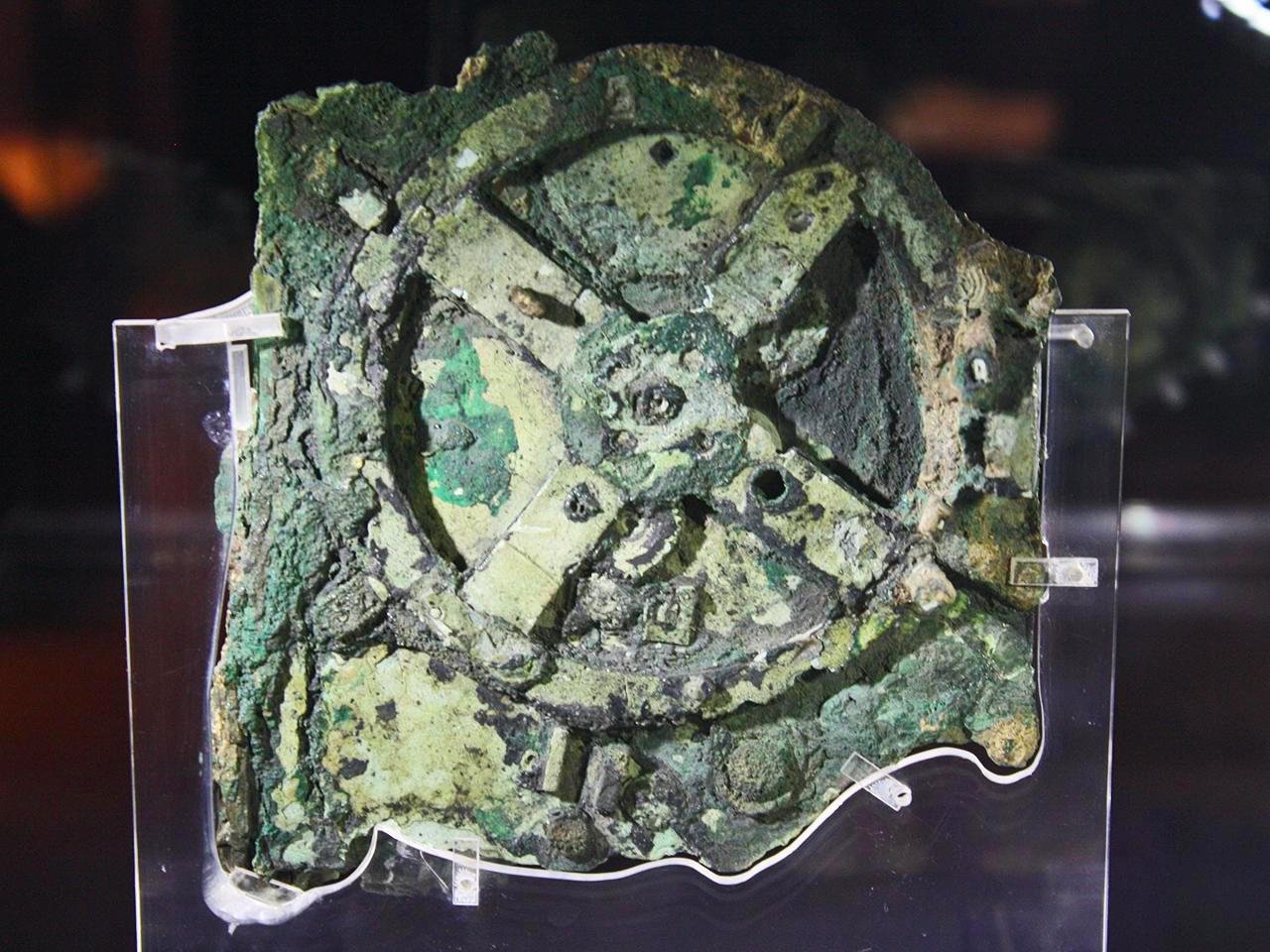 |
| Antikythera Mechanism is the oldest machine of eclipse. |
This extraordinary discovery proved that analog astronomical computation existed long before the digital era.
Astronomy During the Islamic Golden Age
During the Islamic Golden Age, astronomy flourished across Persia, Andalusia, Central Asia, and the Middle East. Muslim scientists successfully translated, preserved, refined, and expanded Greek and Indian astronomical knowledge.Observatories became centers of scientific innovation, and astronomical instruments underwent major development.
Scientists developed:
- Astrolabes
- Celestial globes
- Astronomical tables
- Lunar calendars
- Eclipse calculation systems
The tradition of combining geometry with practical instrument-making became extremely important. In many ways, modern interest in analog astronomical instruments can trace its intellectual roots back to this golden age of science.
The Emergence of the Solar Eclipse Wheel Instrument
One of the most visually fascinating eclipse devices is the solar eclipse wheel instrument. This instrument typically uses rotating disks to simulate the alignment of celestial bodies.Essentially, the eclipse wheel attempts to represent:
- Lunar phases
- Orbital cycles
- Nodal points
- Calendar synchronization
By rotating several disk layers, users can observe how eclipse conditions form when the Sun, Moon, and Earth align in specific positions.
The beauty of this instrument lies in its simplicity.
Instead of overwhelming users with formulas and complicated software interfaces, it transforms astronomy into a compelling visual and physical experience. The rotating motion itself becomes part of the learning process.
Why Are Rotating Astronomy Instruments So Effective?
Modern education often emphasizes speed and automation. However, analog astronomical instruments offer a very different learning experience.When someone manually rotates an eclipse wheel, they begin to understand:
- Cyclical motion
- Orbital repetition
- Lunar synchronization
- Celestial alignment
This creates a deeper conceptual understanding.
Physical interaction can spark curiosity in ways that passive digital consumption often cannot. Students do not simply read about eclipses — they truly explore them.
Understanding the Volvelle
One of the most important analog astronomical devices in history is the volvelle. This instrument consists of layered paper or parchment disks attached to a central pivot so they can rotate freely. In the modern era, the base materials can also be transformed into solid flat materials such as acrylic or brass. |
| Volvelle Eclipse by Philippe De La Hire (France) |
Users rotate these disks to calculate or visualize relationships between astronomical variables.
During the medieval and Renaissance periods, volvelles were widely used for:
- Astronomy
- Navigation
- Calendar calculation
- Astrology
- Eclipse studies
Although they may appear simple, volvelles were actually highly sophisticated information systems. These instruments transformed complex astronomical relationships into visual mechanisms that were both easy to understand and interactive.
How to Use a Volvelle for Eclipse Prediction
One modern search query that frequently appears in historical astronomy discussions is:“How do you use a volvelle for eclipse prediction?”
The answer depends on the type of volvelle being used, but the general principle remains the same.
A volvelle designed for eclipse studies usually contains several disk layers representing astronomical cycles. These layers may include:
- Calendar dates
- Lunar phases
- Zodiac positions
- Eclipse nodal points
- Solar cycles
- Epoch data
Users rotate the disks to align specific astronomical conditions. When the correct alignment appears, the instrument indicates the possibility of an eclipse.
Step 1 — Adjusting the Calendar Scale
The outer disk usually contains dates or months. The user first sets the instrument to a specific time period. This becomes the observational framework for the calculation.
Step 2 — Rotating the Lunar Cycle Disk
Another layer represents the lunar phases. By rotating this disk, the user aligns the Moon’s position relative to the Sun. This is important because solar eclipses only occur during the new moon phase.
Step 3 — Checking Nodal Points or Eclipse Curves
Many eclipse volvelles also include nodal indicators. The Moon’s orbit is tilted relative to Earth’s orbit around the Sun. Eclipses only occur when the Moon crosses these orbital intersection points, known as nodes.
If the new moon occurs near a node, eclipse conditions become possible.
Step 4 — Observing Alignment Patterns
Once all layers are properly aligned, the instrument visually demonstrates the relationship between celestial cycles.
Rather than generating highly precise modern predictions, the volvelle helps users understand why eclipses occur and when eclipse conditions may emerge. This educational function is what keeps the volvelle relevant even today.
Analog Astronomy Instruments and Human Imagination
There is something deeply human about analog instruments. Modern software offers speed and precision, but analog tools offer experiential intimacy. A manually rotated eclipse wheel makes users feel connected to centuries of astronomical tradition. The instrument is not merely a calculator. It also becomes: - An educational tool
- A historical artifact
- A work of art
- A scientific model
- A storytelling medium
This combination explains why interest in analog astronomy instruments for eclipse studies continues to grow today.
Before Computers: Predicting the Sky by Hand
It is difficult to imagine astronomy before the computer era. Today, a smartphone can instantly calculate:- Eclipse paths
- Planetary positions
- Lunar phases
- Celestial coordinates
Yet throughout most of human history, astronomy required patience, observation, geometry, and instrument-making skills. Astronomers copied tables manually. They observed celestial motion night after night.
They designed tools capable of transforming invisible cycles into physical representations. This required both scientific understanding and artistic precision.
In many cases, astronomical instruments were extraordinarily beautiful handcrafted engineering works. Wood, brass, parchment, acrylic, ink, and engraving techniques all played important roles.
The result was a world where science and craftsmanship existed as one unified discipline.
Why Historical Eclipse Calculators Still Matter
At first glance, analog eclipse instruments may appear outdated. After all, modern astronomy software is far more accurate. So why are people still interested in historical eclipse calculators?The answer lies in education, experience, and cultural heritage.
1. Teaching Astronomical Concepts Visually
Many people struggle to understand eclipses through mathematical equations alone. Analog tools simplify complex motion into understandable geometry. By physically rotating disks, users can intuitively understand relationships between celestial bodies.
2. Connecting Science with History
Historical astronomical instruments remind us that scientific knowledge developed gradually across many civilizations. These tools preserve the intellectual legacy of astronomers, mathematicians, instrument makers, and educators from the past.
3. Encouraging Deeper Learning
Modern digital systems often emphasize instant results. Analog tools instead encourage curiosity and exploration. Users spend time interacting with astronomical ideas rather than simply receiving automatic answers.
4. Possessing Artistic Beauty
Many historical astronomical instruments possess extraordinary visual beauty. Circular geometry, engraved symbols, and layered structures create a unique blend of science and art.
The Revival of Analog Astronomy
In recent years, museums, educators, and independent creators have begun reviving analog astronomical instruments. This revival has been driven by increasing interest in:- Tactile learning
- STEM education
- History of science
- Handcrafted design
- Screen-free educational tools
Many educators now realize that physical interaction can improve conceptual understanding.
When students rotate an eclipse wheel themselves, they engage multiple forms of learning simultaneously:
- Visual
- Spatial
- Tactile
- Logical
This creates stronger learning memory.
From Historical Instruments to Modern Interpretation
Modern creators are not simply copying ancient devices. Instead, they reinterpret them for contemporary audiences. This includes:- Educational volvelles
- Eclipse visualization wheels
- Paper astronomy kits
- Artistic scientific instruments
- Modern analog eclipse tools
Some modern designs simplify historical complexity to make them easier for beginners to understand. Others focus more on artistic and collectible value. The result is a fascinating blend of science communication and design.
Reviving Eclipse Instruments Through VOINOVA
One example of this modern reinterpretation movement is VOINOVA, developed by Padepokan Albiruni. Inspired by the intellectual heritage of classical astronomy, VOINOVA seeks to revive astronomical learning experiences through visual and interactive instruments. |
| VOINOVA Hispania is designed to predict eclipses. |
Rather than viewing eclipse prediction solely as digital data, this project emphasizes visual understanding, physical interaction, and scientific storytelling. Its purpose is not to replace modern astronomy software, but to reconnect people with the physical beauty of learning about the sky.
Through rotating mechanisms, layered diagrams, and eclipse visualization systems, projects like VOINOVA attempt to revive the sense of wonder once associated with historical astronomical instruments.
In an era dominated by digital screens, there is something profoundly powerful about learning the sky through touch, movement, and geometry.
The Future of Analog Astronomy
Ironically, the future of analog astronomy may become even stronger precisely because the world has become so digital. As artificial intelligence, automation, and software continue advancing rapidly, people increasingly seek experiences that feel more tangible and human.Analog astronomical instruments offer:
- Slower interaction
- Visual curiosity
- Educational experiences
- Historical connection
- The beauty of craftsmanship
These tools remind us that science is not only about precision — it is also about wonder.
The ancient astronomers who created eclipse wheels and volvelles were not merely calculating celestial events. In reality, they were trying to understand humanity’s relationship with the universe. And that spirit still lives on today.
Currently, the only available analog eclipse instrument is VOINOVA, developed by Padepokan Albiruni. It can be explored through the official websites:
- Padepokan Albiruni [ www.padepokanalbiruni.com ]
- VOINOVA [ www.voinova.id ]